

Your Barix won't tell you the stream dropped. BNM will.
Exstreamer and Instreamer boxes are the quiet workhorses of half the STL and audio-over-IP links in radio. They're cheap, they're reliable — and when one finally chokes, the box sits there silent while you sit there off-air. BNM watches the stream and calls your phone the second the audio stops.
IP: 10.20.14.108:80
Ping: 1ms
| 2026-09-24 19:08 | Buffer high on WPKR Barix TX Site: 65476 bytes (threshold: 25000) | lasted 70s | |
| 2026-09-21 09:58 | Buffer high on WPKR Barix TX Site: 65336 bytes (threshold: 25000) | lasted 3.2d | |
| 2026-09-21 04:42 | Buffer high on WPKR Barix TX Site: 65532 bytes (threshold: 25000)back to 2026-09-15 | lasted 58m | |
| 2026-09-16 08:54 | Stream changed on WPKR Barix TX Site: expected brtp://10.20.14.60:8888, got http://stream.northridge.example:8028/streamback to 2026-08-14 | lasted 4.8d | |
| 2026-09-13 04:34 | Buffer high on WPKR Barix TX Site: 13028 bytes (threshold: 10000) | lasted 76s | |
Recorded telemetry from a live Barix Exstreamer 500 decoder — decoder buffer and reachability. Station, IP and site name replaced with a demo tenant. Not a live feed.
A dropped stream looks exactly like a healthy one — until you listen.
A Barix that's lost its source doesn't light up a panel or send anyone an email. The decoder just stops, the relay sits where it was, and the first sign of trouble is dead air or a phone call from a listener. By then you've been off the air for ten minutes.
BNM treats the stream itself as the thing that matters — not just whether the box answers a ping. It knows the difference between "the device is online" and "audio is actually flowing."
The signals that actually mean off-air.
Not just "is it pingable." BNM tracks the things that tell you whether your STL is really carrying audio.
Stream up / down
Whether the decoder is locked to its source and audio is present — the one thing that defines on-air.
Bitrate & buffer
Bitrate, codec and buffer health, so you catch a link starving before it drops entirely.
Source reachability
Whether the upstream source the Barix is pulling from is actually answering.
Audio presence
Real audio level at the output — so silence on a "connected" stream still trips the alarm.
Device health
Uptime, firmware and relay state, so a box about to fall over shows itself early.
Full event history
Every dropout, how long it lasted, and how it cleared — kept on record for every box.
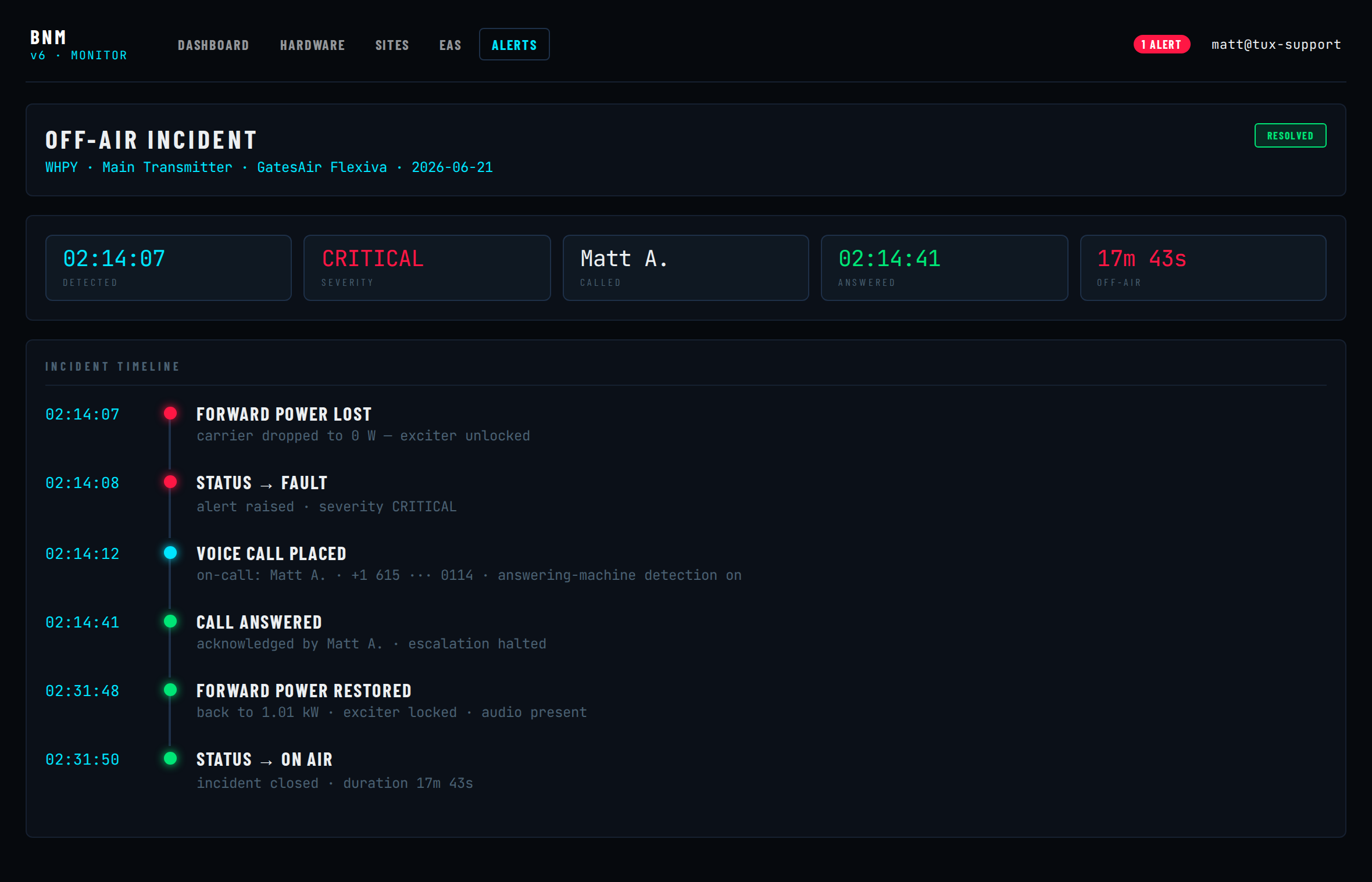
What happens the moment a Barix goes quiet.
Stream stops
Audio goes absent past the threshold. BNM flags NO STREAM in seconds — not minutes.
Voice + SMS + email
It places a real phone call and fires SMS and email to your on-call group at the same time.
Down the call list
No answer? It walks your call-down order, engineer to engineer, until a human picks up.
Logged & cleared
When the stream re-locks, it records total time off-air and archives the whole incident.
Alerts you'll actually trust at 3 a.m.
An alert system that fires on every momentary blip is one you'll mute within a week — and a muted alert is no alert at all. BNM's Barix driver is tuned to tell a real dropout from a one-packet hiccup, so a 3 a.m. phone call means something is genuinely wrong.
- ✓Sustained-loss thresholds, not single-packet twitches
- ✓Receiver-side checks that don't false-alarm on a healthy stream
- ✓Recovery is logged too — you see it came back, and when
- ✓Per-device routing, so the right person gets the right box

The Barix boxes BNM speaks to.
Decoders, encoders and STL pairs — monitored the same way, on the same screen as the rest of your chain.
Stop driving out to a site to find out if the stream's up.
We'll point a demo at one of your Barix links, wire a test dial-out to your phone, and show you a real NO STREAM alert before you ever need a real one.